
Stonecrest Directory Collections by Era
Stonecrest incorporated in 2017, so no long printed run bears its present name. Useful city directory collections were cataloged for places that covered today's Stonecrest geography. DeKalb County Public Library starts its shelf in 1928. DeKalb History Center holds one DeKalb-only book, selected eastern-suburban volumes, and a broad but incomplete Atlanta series. Emory supplies an older digital run that can follow a person before a move east.
| Collection | Years represented | Keeper | Access |
|---|---|---|---|
| DCPL directories | 1928 forward, gaps unspecified | Decatur Library | Print, microfilm; some onsite only |
| DeKalb-only directory | 1939 | DeKalb History Center | Onsite or reference request |
| Tucker/Stone Mountain | 1970, 1972, 1974-1976 | DeKalb History Center | Eastern DeKalb coverage |
| Atlanta city/suburban | Scattered 1887-1990 | DeKalb History Center | Incomplete |
| Digitized Atlanta | 1859/60-1922 | Emory | Free scans and OCR |
No official finding aid identifies the publisher of every book. Holding a suburban volume also does not prove that every current Stonecrest street appears. Ask staff about the exact year and area before drawing a conclusion from an empty search.
Stonecrest Research at Decatur Library
The Decatur Library local-history collection is at the second-floor Reference Desk, 215 Sycamore Street. It joins city directories with Georgia census microfilm, newspapers, Sanborn maps, cemetery records, and vital indexes. Some items stay inside the library, so staff help is an important access channel when no scan exists.
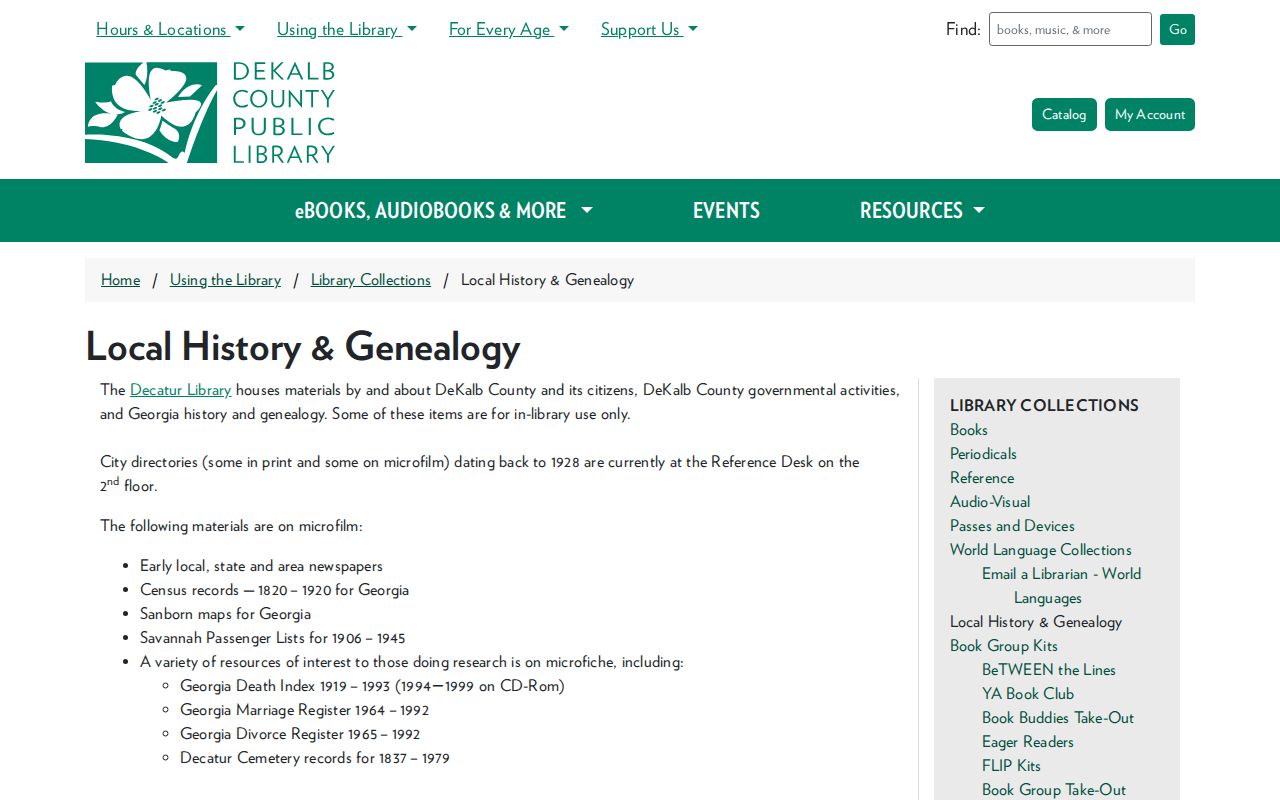
The image confirms a wider research shelf for years that a directory misses. Stonecrest Library offers public computers and reference help, but the deeper local-history collection is centralized in Decatur. The library also holds the Georgia Death Index for 1919-1993 on microfiche and 1994-1999 on CD, marriage registers for 1964-1992, and divorce registers for 1965-1992. Those indexes are leads, not unrestricted certificates.
Stonecrest and the 1939 Book
The DeKalb History Center finding aid identifies 1939 as its only DeKalb-only city directory. This book sits between the 1930 and 1940 federal census schedules. Find a household, copy the full address and occupation, then compare both census years. A change may point to a move, spelling variation, or different listing practice.
One volume cannot stand for all of Stonecrest. Rural routes, households outside publisher coverage, and communities overlooked by commercial directory work may be absent. The Center also keeps oral histories, photographs, newspapers, biographical files, and some court material. These sources can restore names and context that a printed directory missed.
Stonecrest in Suburban Directory Runs
Tucker and Stone Mountain city directories survive for 1970, 1972, and 1974 through 1976. They are more promising for eastern and southeastern DeKalb than Atlanta city-only books. Until 1956, Atlanta and suburbs shared one volume. Growth then forced separate city and suburban books, so the right half of a split run matters.
The Atlanta holdings extend through 1990 but have gaps. “Both” in the finding aid means that city and suburban books survive for that year. It does not mean either book contains every address. Search Lithonia and Stone Mountain headings, subdivision names, road variants, and rural-route forms before treating a miss as proof.
Search Stonecrest Names in Scans
The DCPL genealogy guide links physical research with online genealogy tools and Atlanta directory scans.

Search optical character recognition, or OCR, first. Then inspect the page. Initials, narrow columns, and ditto marks often defeat automated text. Save the title page and abbreviation key with the entry.
The Emory Digital Collections holds Atlanta scans from 1859/60 through 1922.

Those books predate most modern Stonecrest subdivisions, but can trace a family before a move east. They are not a complete online Stonecrest city directory.
Read a Stonecrest Directory Entry
A local city directory entry can contain far more than a name. Its symbols vary by year and publisher, so the key printed in the book controls their meaning.
| Name | Surname, given name, and often an initial |
|---|---|
| Family note | Spouse in parentheses; “wid” may mean widow |
| Work | Occupation and sometimes employer |
| Residence | House number and street; “h” or “r” may appear |
| Ownership mark | Meaning must be checked in that volume |
- Criss-cross directory
- A section arranged by street and house number.
- Householder index
- An address list focused on the named householder.
- Abbreviation key
- The volume's guide to shortened jobs and status marks.
An entry identifies the person the publisher listed, not every person at the address. Children, boarders, rural families, and omitted communities may not appear.
Trace Stonecrest Families Across Years
Family research works best one available volume at a time. Match place names to the search year rather than today's mailing label.
- Test Lithonia, Stone Mountain, and unincorporated DeKalb labels.
- Find the surname and copy the complete entry.
- Use the reverse section, if present, to inspect the address.
- Move forward and backward through each available year.
- Pair 1930, 1940, and 1950 entries with each public census.
- Bridge gaps with deeds, tax records, newspapers, obituaries, and probate.
A first appearance suggests arrival. A disappearance may mean a move, death, omission, or choice not to list. It proves none alone. Modern leads can be checked through the Stonecrest resident lookup.
Flat Rock Names Beyond Directories
Flat Rock Archives preserves community memory that printed city directories can understate. Post-emancipation schools, churches, cemetery ties, civic groups, oral histories, and family papers reach into one of DeKalb's oldest African American communities. This record matters when publishers favored titleholders, dense streets, or subscribers.
Use archive descriptions and contact staff for relevant holdings. Do not assume a public member directory exists. Quarry and railroad occupations may also separate people with the same name around Arabia Mountain and historic Lithonia.
Stonecrest Records Before 1842
The DeKalb History Center archives describe the courthouse fire that left only one known official county-record volume.

No city directory can replace that lost chain. Later deeds reciting older title, tax digests, estates, church files, land-lottery material, family Bibles, and newspapers must be compared. A neat pre-fire trail deserves caution unless each link has surviving support.
Work backward from a proven later person rather than searching the missing era in isolation. Land-lottery references can place a tract, while later estate and deed recitals may preserve an earlier surname. Church, cemetery, tax, and newspaper evidence can then test whether those references concern the same family. Record the source and date for each link. A repeated surname alone cannot repair the gap.
Stonecrest City Directory Timeline
The surviving record has several clear milestones. DeKalb County began in 1822, but the 1842 courthouse fire broke the early official chain. Scanned Atlanta books begin with 1859/60. The History Center's scattered paper holdings start in 1887, while the library shelf begins in 1928. A DeKalb-only volume appears in 1939. Atlanta and its suburbs shared books through 1956, then growth caused city and suburban editions to split. Selected Tucker and Stone Mountain books survive in the 1970s. Listed city and suburban holdings reach 1990. Stonecrest's incorporation in 2017 created a new municipal label, but did not rename old entries.
| Milestone | Why it matters |
|---|---|
| 1859/60 | Emory's digitized Atlanta run begins |
| 1928 | DCPL's directory shelf begins |
| 1939 | The only listed DeKalb-only book |
| 1956 | City and suburban books separate |
| 1970-1976 | Selected eastern-suburban volumes survive |
| 2017 | Stonecrest starts its municipal record era |
A directory search must change labels as it moves through time. A modern address may be Lithonia in one source, Stone Mountain in another, and a subdivision or rural route in an earlier book. Save each title page and coverage note with the entry. That keeps a valid match from being rejected just because the current Stonecrest name is absent.